Barcelona is one of the best-connected cities in Europe and, in this 2026, it has an extensive transport network that covers the entire area, making it easy to travel from anywhere in the city. Getting around the City of Counts is not only simple, but it is the best way to immerse yourself in its vibrant pace. At HCC Hotels, we have prepared this updated public transport guide so you know how to get around Barcelona like a true local, optimizing your time and your budget.
If you are planning your visit, you will discover that Barcelona is a city designed both for citizens and travelers. The integration of services and digitalization mean that, from the moment you step out of one of our hotels, you have the city at your feet.
Metro in Barcelona: the easiest way to get around in Barcelona
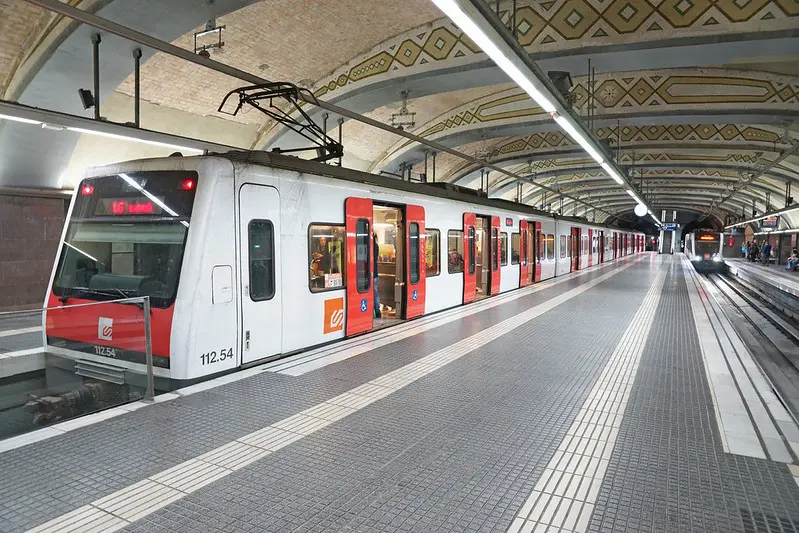
To get around Barcelona like an expert, the first thing you must understand is that the metro is the best option. It is fast, avoids traffic, and has such a high frequency that you will barely have to wait a few minutes on the platform. To avoid surprises, it is vital that you know the timetables, lines, and fares.
2026 Barcelona Metro Timetables
If it is your first time in the city, I advise you to download the Barcelona metro map on your mobile, but above all, be clear about when the last train passes. There is nothing more typical than going out for dinner and wondering if the metro is still open.
- Monday to Thursday and public holidays: From 5:00 am to 12:00 am (midnight).
- Fridays and eves of public holidays: From 5:00 am to 2:00 am.
- Saturdays: Continuous service all night. The metro does not close from 5:00 am on Saturday until 12:00 am on Sunday.
- Sundays: Until 12:00 am (midnight).
Local tip: If you see the clock strike 11:55 pm on a Tuesday, do not run desperately; if you enter the station before 12:00 am, you will most likely still be able to get on the last train sweeping the line.
What if the metro is closed? The NitBus to the rescue
If you find yourself outside of metro hours, do not worry, there is no need to walk for miles. Barcelona has an excellent night bus network called NitBus.
Tips for your first trip on the Barcelona Metro
- Direction of travel: On the platforms, you will see the line number and the route of the line you are on. Always check the map to know which direction you are going (for example, L3 direction Trinitat Nova or direction Zona Universitària).
- Transfers: Barcelona allows you to combine different metro lines with a single ticket, but beware! The connecting corridors in stations like Passeig de Gràcia can be quite long. Keep this in mind if you are pressed for time.
- Vigilance: The metro is very safe, but as in any major tourist city, keep your belongings in sight and wear your backpacks on your front in crowded carriages.
2026 Barcelona Metro Fares: Which ticket should I buy?
Unlike other cities, transport in Barcelona is integrated: with the same ticket, you can use the metro, bus, tram, and local trains (FGC and Rodalies/Cercanías) as long as you do not leave Zone 1. In 2026, these are the options you will find at the ticket machines:
- T-casual (€13.00): This is the star card for short visits. It includes 10 journeys and is unipersonal (you cannot validate it twice in a row for another person to pass).
- T-usual (€22.80): If you are going to be in Barcelona for more than three days or plan to move around a lot, this is your best ally. It offers unlimited journeys for 30 days for a very competitive price. Once you make 18 trips, it will have paid for itself!
- T-familiar (€11.50): Ideal for groups or families who will make few trips. It includes 8 journeys and, unlike the T-casual, this one is multi-person.
- Hola Barcelona Travel Card: If you don’t want any complications, this tourist card allows you to travel without limits for 2, 3, 4, or 5 days (from €18.70). Additionally, it includes the round-trip Airport supplement, which separately costs €5.90 per journey.
Buses in Barcelona: enjoy the city while you travel
Barcelona has a very complete urban bus network and, for many, it is the most pleasant way to get around. Unlike the metro, the bus allows you to sit by the window enjoying the city’s architecture and the hustle and bustle of its streets. Just keep one important detail in mind: travel time depends entirely on traffic, so if you have an appointment at a set time (like a restaurant reservation or museum entry), we recommend leaving with some extra time.
How to identify your bus?
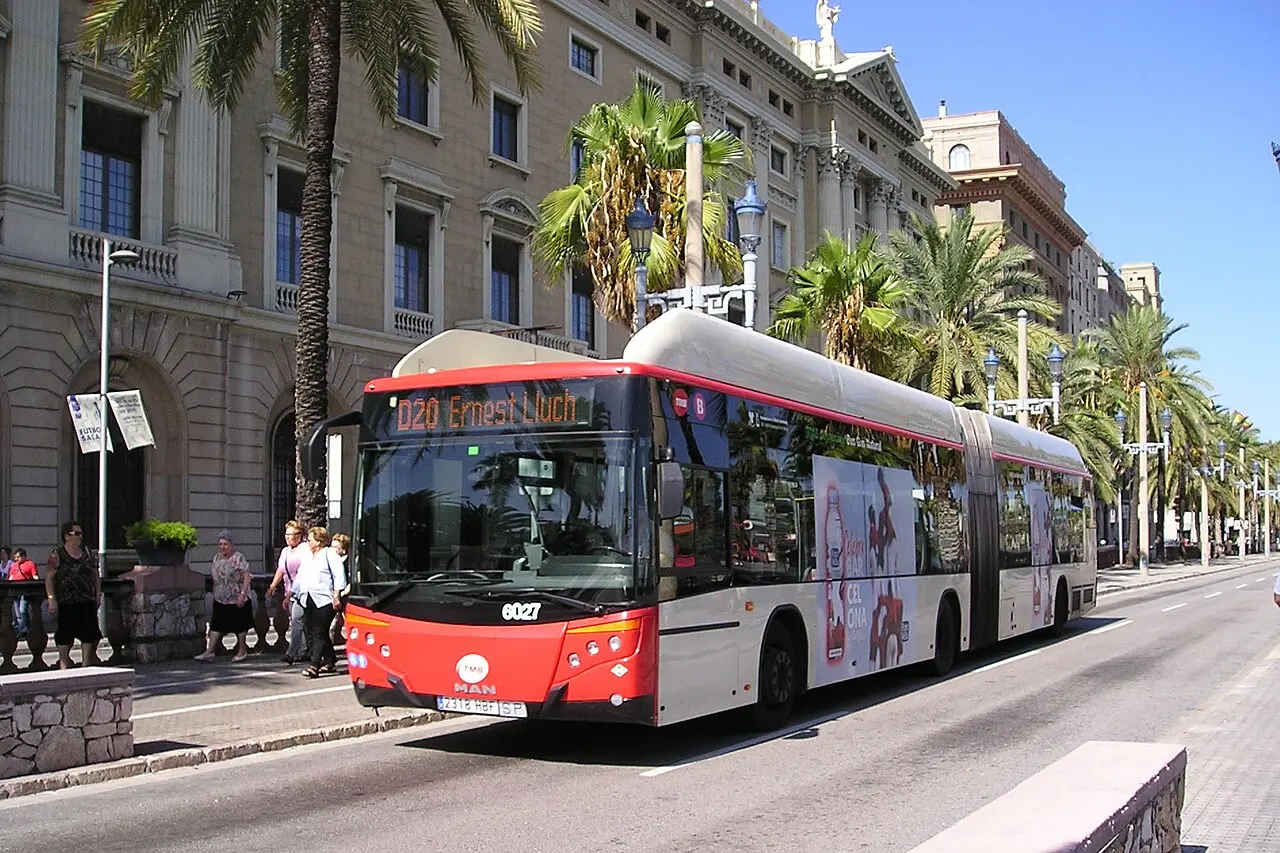
Buses in Barcelona are easily recognizable by their red and white colors. On the front and side, you will see the line number. To avoid confusion, there are several types; we advise you to check the Barcelona bus map.
- Regular lines: Identified simply by a number.
- Orthogonal Network (Rapid transit): These are lines that cross the city more directly. They carry the letter V (Vertical), H (Horizontal), or D (Diagonal), followed by a number.
- Nitbus (Night service): When the daytime lines finish, buses with the letter N come into play.
2026 Barcelona Bus Timetables and Frequencies
Bus timetables vary by line, but the general rule is that they operate from 5:00 – 6:00 am to 10:00 – 11:00 pm.
- In real time: At almost all stops you will find luminous panels indicating how long until the next bus (iBus system). If there is no panel, you can check it on the TMB website or App.
- Frequency: It rarely exceeds 15-20 minutes, although the main lines pass every few minutes.
What happens when night falls? The Nitbus
From 10:00 – 10:30 pm, the daytime network withdraws and the Nitbus service begins.
Local tip: Except for line N0 (which is circular), all Nitbuses pass through Plaza Catalunya.
The night service runs until 5:00 – 5:30 am in the morning, linking perfectly with the opening of the metro. The best thing is that the price and tickets (T-casual, T-usual, etc.) are exactly the same as during the day.
Unified metro and bus fares: 2026 Barcelona Bus Fares
One of the great advantages of the transport system in Barcelona is that it is completely integrated. This means that bus fares and tickets are exactly the same as for the metro. You don’t need to buy a different pass; if you already have a T-casual, a T-usual, or are using the Hola Barcelona Travel Card in your pocket, you can hop on the bus without any worries.
Furthermore, the system rewards your mobility: thanks to fare integration, you have 75 minutes from the first validation to make free transfers. For example, you can leave one of our hotels, get on the metro, and then link up with a bus to get right to the door of your destination; as long as you are within that timeframe and do not leave Zone 1, the system will only deduct a single journey.
Remember: Even if you come from the metro and have already validated there, it is mandatory to pass your card through the validating machine again when boarding the bus so that your journey is legal.
Tips for your bus trip
- Enter through the front: On buses, you always board through one of the first two doors and exit through the middle or rear doors.
- Validate when boarding: The validating machine is right next to the driver. Remember that if you transfer from the metro and are within the 75 minutes, it will not charge you another trip when you scan your card.
- Request stop: Unlike the metro, the bus does not stop at all stops if no one requests it. Press the red button in advance when you see your destination on the interior screens.
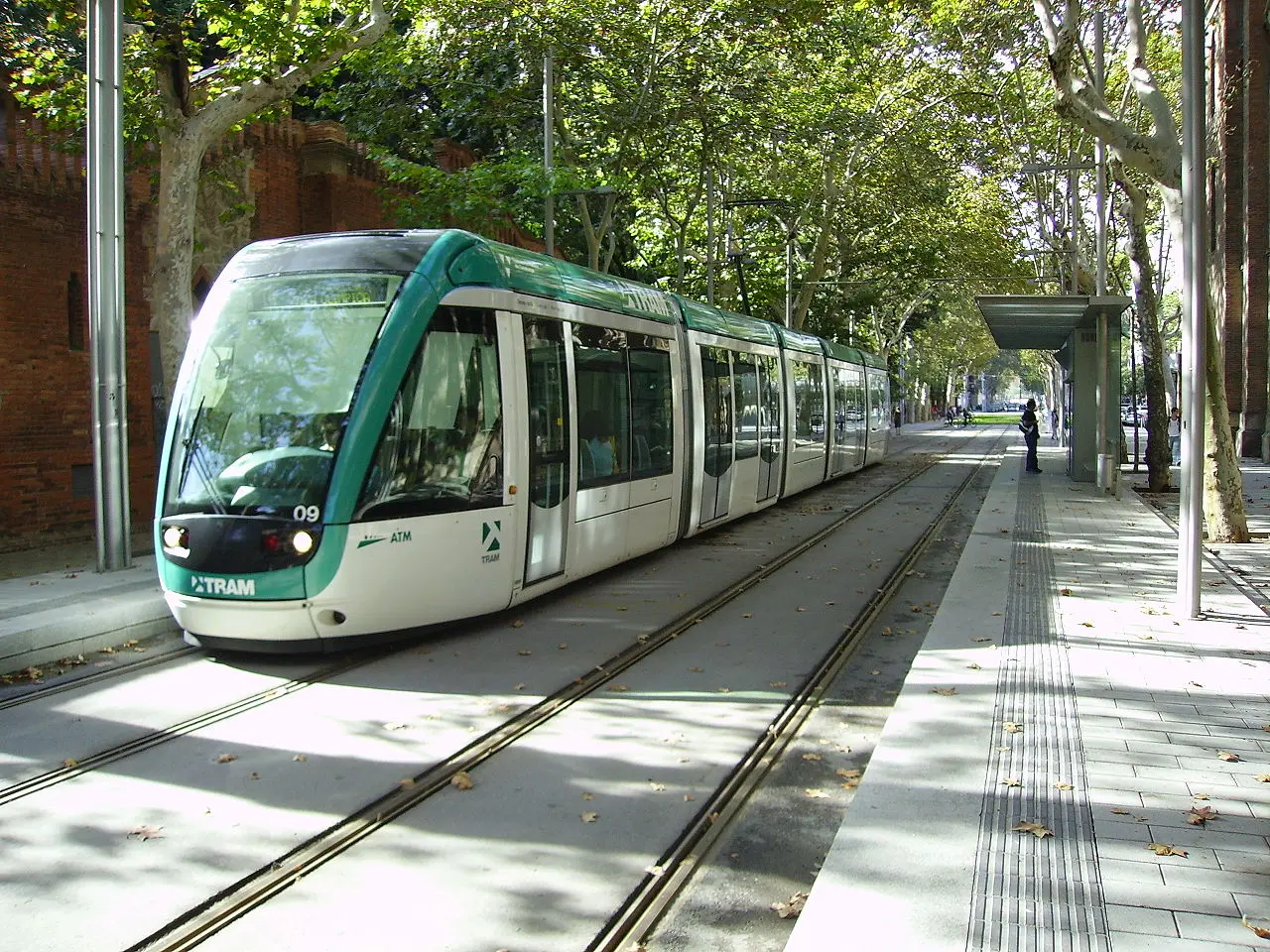
The Tram in Barcelona (TRAM): comfort and modernity on the grand avenues
The tram is probably the most comfortable and spacious transport in Barcelona. Although it has a modern and efficient network, it is quite possible that, if you focus only on the historic center, you may not get to use it, as its tracks mainly cover the large extensions reclaimed from the sea and the arteries connecting with neighboring cities. However, it is a fantastic experience if you want to move with natural light and without the bumps of the bus.
The Barcelona tram lines you need to know
Barcelona Tram map divided into two zones: the Trambaix (towards the south) and the Trambesòs (towards the north).
- Besòs Network (T4, T5, and T6): This is the one that usually interests visitors the most. Line T4 is our personal recommendation: it starts at the Parc de la Ciutadella (Ciutadella | Vila Olímpica station) and runs along Av. Diagonal to the Fòrum, passing through Glòries, where you can admire the iconic Torre Glòries up close.
- Baix Network (T1, T2, and T3): They connect the university zone with municipalities like Cornellà or Sant Feliu, covering a large part of the upper Diagonal.
2026 Barcelona Tram Timetables (TRAM)
The tram schedule is very similar to that of the metro, making it very easy to plan your route:
- Monday to Thursday and Sundays: From 5:00 am to 12:00 am.
- Fridays, Saturdays, and eves of public holidays: From 5:00 am to 2:00 am.
2026 Barcelona Tram Fares and Tickets: How to pay for the tram?
As with the bus, tram fares are integrated. This means you can use your usual cards (T-casual, T-usual, T-familiar) or the Hola Barcelona Travel Card tourist card.
- If you use a single ticket: The price in 2026 is €2.90. Keep in mind that the single TRAM ticket only allows transfers between tram lines for 30 minutes, but does not allow transferring to the metro or bus. Therefore, we always recommend using integrated cards.
- Transfers: If you use an integrated card, you can switch from the metro to the tram for free as long as you are within the allowed 75 minutes.
What about the Tramvia Blau?
If you have read about a historic blue tram that goes up towards Tibidabo, you should know that this is the Tramvia Blau, a gem with over 100 years of history. However, it is currently closed for maintenance, so to get up to the Tibidabo area you will have to use the bus or the funicular.
Tips for using the TRAM
- Always validate on the platform or inside: Depending on the stop, the validating machines may be on the platform itself or inside the carriage. Don’t forget to scan your card!
- Total accessibility: The tram is the most accessible transport in the city. The floor of the carriage is exactly level with the platform, making it perfect if you are traveling with a stroller or in a wheelchair.
- Stops on demand: As with the bus, you must press the door open button when approaching your stop.
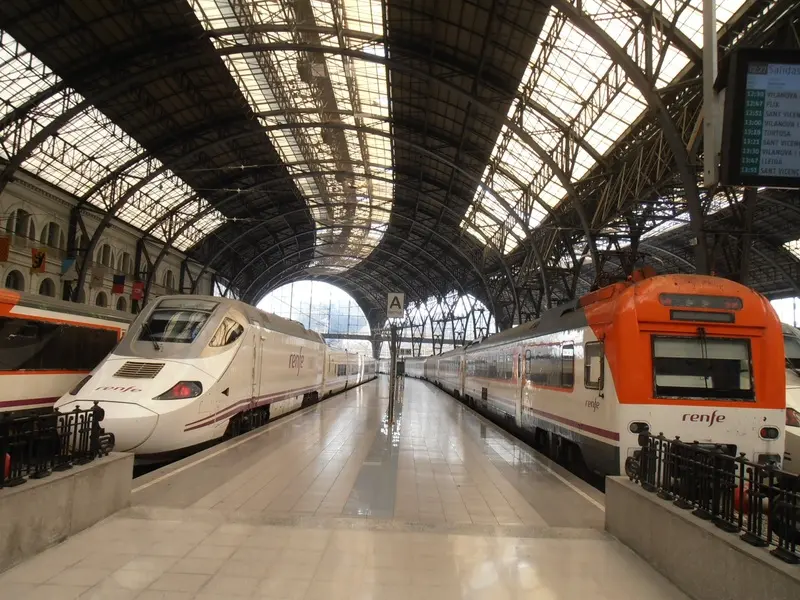
Ferrocarrils (FGC) and Rodalies in Barcelona: the trains that connect the city and its surroundings
In addition to the metro and bus, Barcelona has two train networks that, although they seem similar, have very different functions. The most important thing you should know is that both are integrated into the fare system, so you can use your T-casual or T-usual card as long as you move within Zone 1.
Ferrocarrils de la Generalitat (FGC): the “other” metro
The Ferrocarrils are a light rail network that, in practice, operates like an extension of the metro within the city. As a historical curiosity, the Sarrià line was the second urban railway in the world (after London), opened in 1863.
- What are they for? They are ideal for reaching areas of the capital where the conventional metro does not go, such as the upper zone neighborhoods (Sant Gervasi, Sarrià, or the foothills of Tibidabo) or for taking trips to nearby towns like Terrassa or Sabadell.
- Full integration: Within Barcelona, the FGC appear on maps as lines with the letter “L” (like L6 or L7) or the letter “S” (like S1 or S2). You can enter and exit using the same ticket as the metro.
Rodalies (Commuter Trains): long-distance trains
The Rodalies are the commuter trains operated by Renfe. They connect Barcelona with the rest of Catalonia and are the most direct option for day trips to places like the beaches of Sitges or the Maresme.
- Key lines: The network is extensive, but the most relevant for travelers is usually the R2 Nord, which is the one connecting El Prat Airport (T2) with central stations like Sants or Passeig de Gràcia.
- Watch out for zones: Although they accept Barcelona transport cards, you must be very careful with the zones. While the airport is Zone 1 for the Metro, it is considered Zone 4 for Rodalies if you buy a single Renfe ticket.
- Recommended use: Except for the trip to the airport or if you decide to visit a coastal town, it is unlikely that you will need to use Rodalies to get around the tourist center of Barcelona.
Practical facts for trains
- Validate on entry and exit: Unlike the metro or bus, at many FGC and Rodalies stations, you will need your ticket for the doors to open both when entering and exiting. Don’t leave it at the bottom of your backpack!
- Shared stations: In main stations like Plaça Catalunya, Sants, or Passeig de Gràcia, the Metro, FGC, and Rodalies coexist. Look closely at the logos on the signboards to follow the right path.
- Same price: Remember that if you use an integrated 1-zone card, the price is the same as the metro and you have the same 75 minutes to transfer between train, bus, or metro.
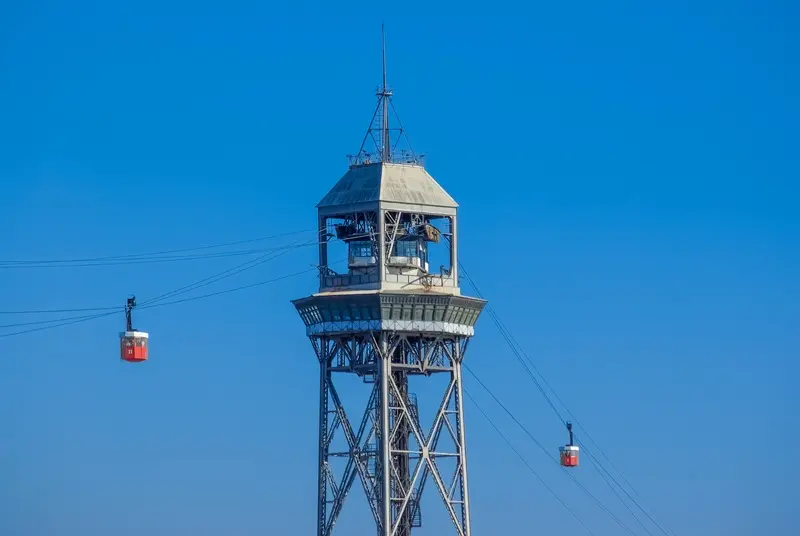
Funiculars and cable cars: how to get around Barcelona through the heights
Barcelona is a city of contrasts between the sea and the mountain, and to overcome these slopes there are transports that are, in themselves, a tourist attraction. If you are looking for the best panoramic views or want to reach the highest points of the city effortlessly, these are the means you need to know:
Integrated Funiculars (Price of a Metro journey)
The great news is that some of these funiculars are part of the public transport network, so you can use them with your T-casual, T-usual, or Hola Barcelona card without paying a single cent extra.
- Montjuïc Funicular (FM): In practice, it is like an extension of the metro. It is taken at the Paral·lel (L2 and L3) station and drops you off at the Parc de Montjuïc in just 2 minutes. It is the fastest and cheapest way to start your route across the Olympic mountain.
- Vallvidrera Funicular: Managed by FGC, it connects the Sarrià train station with the Vallvidrera neighborhood, in the upper area. It is fully remodeled and offers you a unique perspective of the city as you ascend the Collserola mountain.
The ascent to Tibidabo
- Tibidabo Funicular (Cuca de Llum): It was the first to be built in Spain (1901) and today it is a futuristic-design train that takes you directly to the Tibidabo Amusement Park.
- 2026 Price: Being a private transport, the “Cuca de Llum” ticket is included in the entrance to the park or the panoramic area (from €39 adults), but if you only want the round trip, the price is around €13.50. You cannot pay with ordinary integrated cards.
Cable cars: the best views of the city
If what you are looking for is an experience “flying” over Barcelona, you have two spectacular options, although neither of them is integrated into the transport system:
- Montjuïc Cable Car: It departs from the same station where the Montjuïc Funicular drops you off and goes up to Montjuïc Castle.
- 2026 Prices: The round-trip adult ticket costs €19.00 (although if you buy it online you get a 10% discount, making it €17.10). Children from 4 to 12 years old pay €13.00.
- Port Cable Car (Transbordador Aéreo): The iconic red cable car that crosses from Barceloneta (Torre San Sebastián) to Montjuïc mountain (Miramar).
- 2026 Prices: The price stands at €12.50 one way and €20.00 round trip.
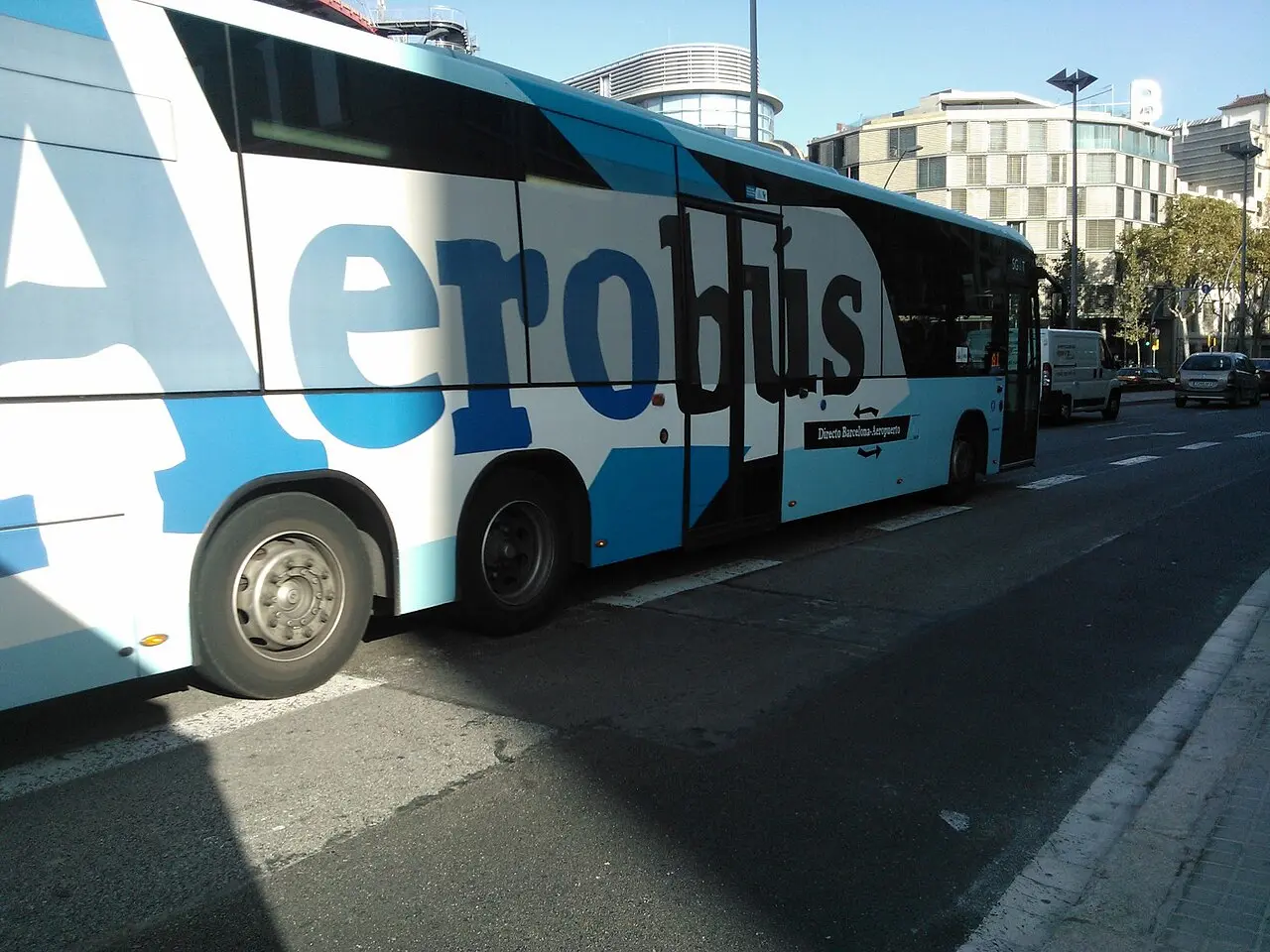
How to get from Barcelona Airport to the center
1. Aerobús (A1 and A2): The most balanced option
The Barcelona Aerobús is the express bus service connecting both terminals with Plaza Catalunya in about 35 minutes. It is ideal if you are carrying suitcases, as it features ample luggage racks and onboard WiFi.
- 2026 Price: A single ticket costs €7.75 and a round trip is €13.30 (the return is valid for up to 90 days).
- Frequency: Every 5-10 minutes.
- Advantage: Operates 24 hours a day.
- Watch out: You cannot use integrated cards like the T-casual or T-usual. They only accept their own ticket or the Hola Barcelona tourist card.
2. Rodalies Train (R2 Nord): The fastest airport-center option (T2 only)
If you are looking for speed and economy, the train is unbeatable. It leaves from Terminal 2 and drops you off at key stations like Sants (19 mins) or Passeig de Gràcia (26 mins).
- 2026 Price: If you buy a single Renfe ticket it costs around €5.15 (4 zones).
- Connection between terminals: If you arrive at T1, you will need to take the free bus (shuttle) that links the two terminals to reach the train station.
3. Metro (Line L9 Sud): The connection to the neighborhoods
The metro connects both terminals (T1 and T2) with the southern area of Barcelona. It is very useful if your hotel is near the Fira or the Zona Universitària.
- 2026 Special Price: A normal single ticket is not valid. You must buy the Airport Ticket, which this year costs €5.90.
- Integration: If you have the T-usual or the Hola Barcelona, this journey is included and you do not have to pay a supplement.
- Important: To reach the center (Plaza Catalunya), you must transfer at stations like Torrassa (L1) or Collblanc (L5), which extends the time to about 50-60 minutes.
4. Taxi: Door-to-door comfort
If you are traveling in a group or with a lot of luggage, a taxi is the most comfortable option.
- 2026 Price: The trip to the center is usually around €35 – €45 (depending on the terminal and traffic).
- Minimum fares: There is a minimum departure fare from the airport of €21.00 (including supplements).
Barcelona is an invitation to experience the city with all five senses. Getting around by public transport allows you to blend in with its people and discover corners that don’t appear in conventional guides.
At HCC Hotels, we want your only worry to be enjoying yourself. Therefore, our hotels are strategically located near the main transport hubs, ensuring that comfort and hospitality accompany you on every journey. We look forward to seeing you!