Barcelona is preparing to experience a Diada de Sant Jordi 2026 that promises to be historic, consolidating itself not only as the festival most beloved by its citizens but as one of the most fascinating cultural spectacles in the world. On April 23rd, the City of Counts sheds its routine to transform into an immense open-air bookstore and florist, where the scent of fresh roses mixes with the smell of new paper under the spring sun. This year, the celebration takes on an even deeper nuance as it coincides with the epicenter of the Gaudí Year, making the mysticism of his legend resonate more strongly among the modernist facades that serve as the stage for this day dedicated to love and intellect.
Strolling through the streets of Barcelona on this special day is to participate in a collective ritual where time seems to stand still: thousands of people walk through the “Literary Superblock” with a rose in hand and the hope of finding that book capable of changing their lives. At HCC Hotels, we are aware that experiencing Sant Jordi 2026 is an experience that marks a before and after in any trip; therefore, we have designed this exhaustive guide, the most complete you will find, so you don’t miss a single detail, from the most intimate literary dialogues to the most artisanal rose stalls, ensuring that your stay in the heart of the festivity is as magical as the legend itself that sustains it.
1. The Sant Jordi 2026 Poster: the visual identity of the festival
Every edition of Sant Jordi officially begins when the Barcelona City Council presents its poster. For this 2026, the graphic image is not just a decorative element, but a declaration of intentions that floods every bus shelter, banner, and shop window in the city. This year’s poster has been designed to capture the essence of a Barcelona that looks to the future without letting go of its deepest roots.
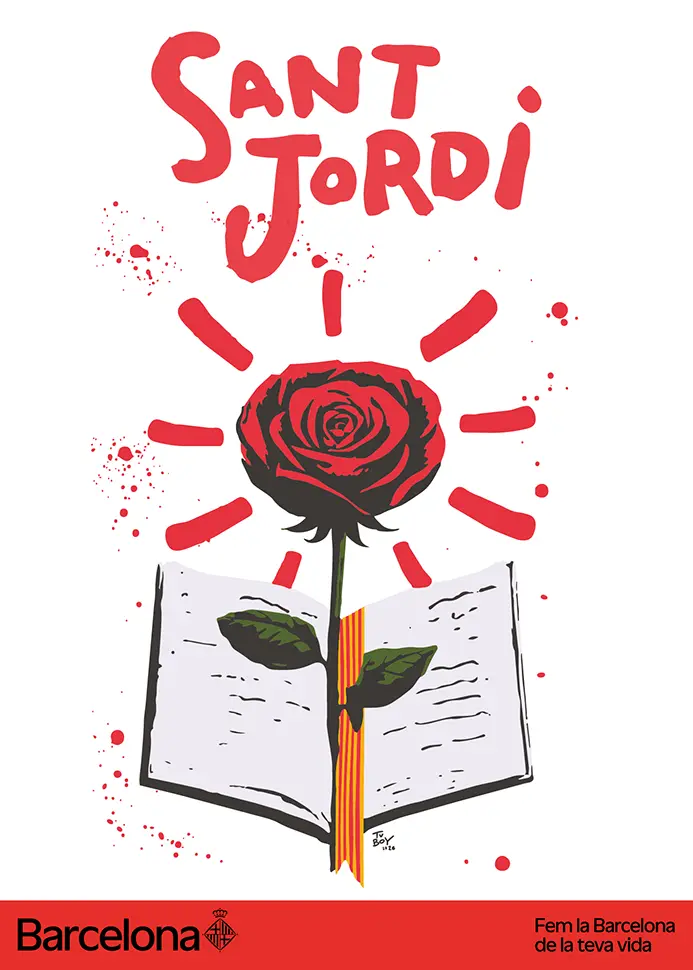
The official poster for Sant Jordi 2026 marks a milestone in the graphic history of the city by featuring the signature of TVBoy, the renowned internationally projected urban artist based in Barcelona. This choice is no coincidence: it represents the perfect union between the tradition of the Diada and the cosmopolitan, rebellious spirit of street art that defines modern Barcelona.
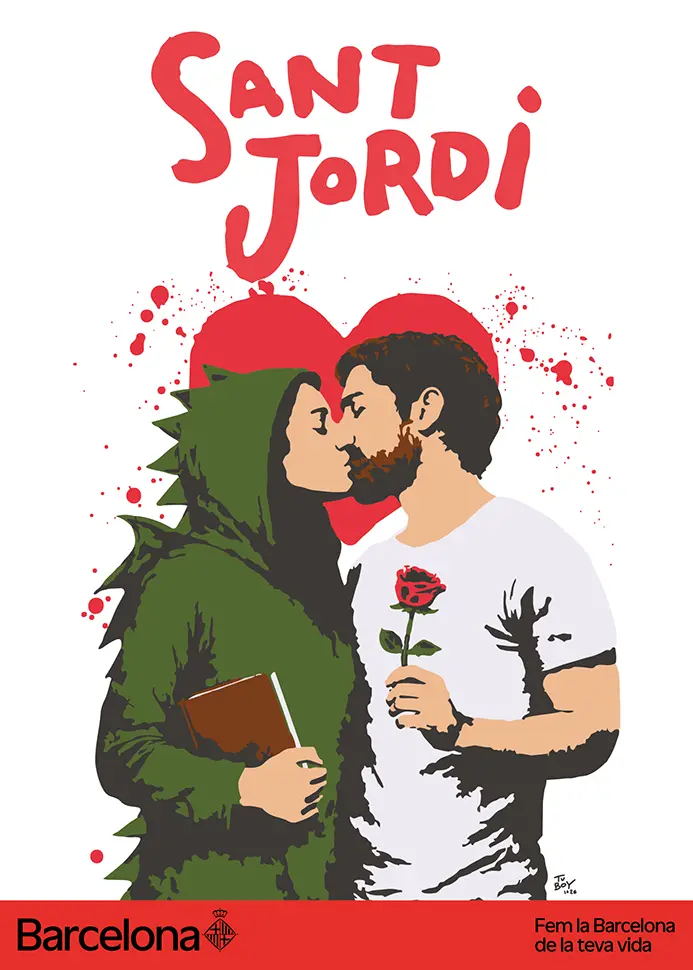
The concept: “The most revolutionary gesture is to love”
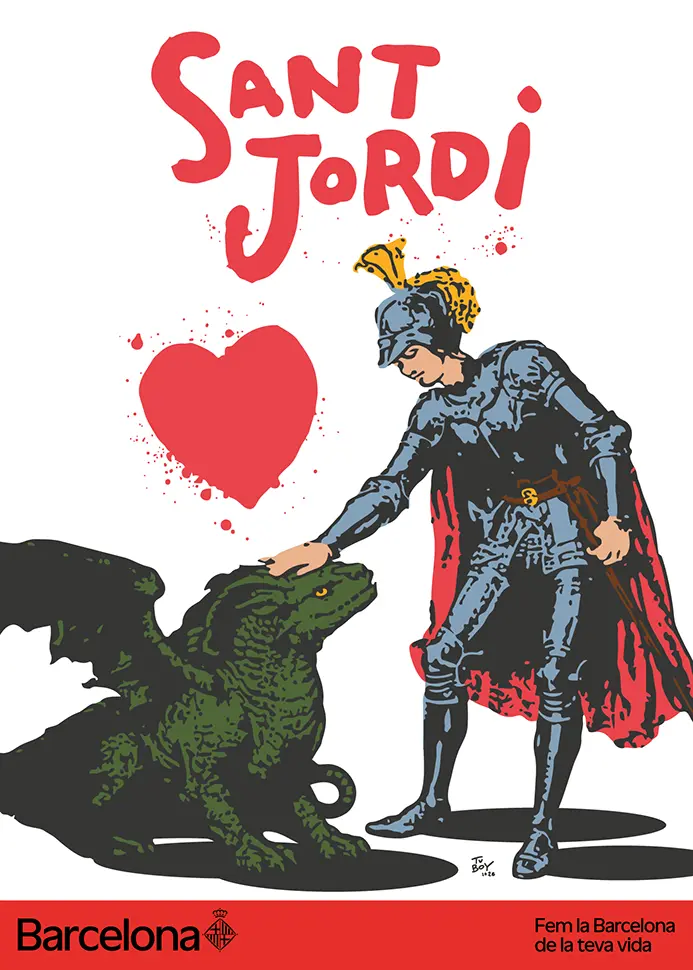
TVBoy’s proposal for this year breaks with the classic narrative of conflict and confrontation. Instead of depicting the fight between St. George and the dragon, the artist proposes a contemporary revision of the myth centered on empathy. According to official information from the City Council:
- From violence to tenderness: The poster moves the legend away from aggressiveness to place love at the center of the public sphere. In this vision, combat is transformed into a bond and confrontation into a symbolic embrace between the city and its citizens.
- Updated symbology: TVBoy masterfully reinterprets traditional icons: the dragon’s blood becomes paint, reminding us that art and culture are the only weapons capable of transforming reality. The violence of the spear fades away to give way to the tenderness of the rose.
- Iconic and urban aesthetics: the poster uses the “urban pop-art” style that has made the artist famous in cities like Milan, London, or New York. It is a direct, powerful, and deeply communicative image that seeks to connect with all generations.
A poster for the public sphere
This 2026 design aims to make whoever views it reflect on coexistence. By placing empathy at the center of the public sphere, the poster reminds us that, in a diverse society, the act of giving a book or a rose is, in reality, a gesture of peace and understanding.
Ali Smith: opening speaker for Sant Jordi 2026
Within the special programming for this year, the figure of Ali Smith shines brightly, chosen as the Reading Town Crier (Pregonera de la Lectura) 2026. The Scottish writer, a member of the Royal Society of Literature and responsible for revolutionizing Anglo-Saxon narrative with works like The Accidental or her acclaimed seasonal tetralogy (Autumn, Winter, Spring, Summer), will be in charge of officially inaugurating the literary aspect of the festival.
During the event, Smith will converse with translator Dolors Udina about the vital role libraries have played in her career and will present her most recent 2026 essay, A Woolf of Her Own, a contemporary reinterpretation of Virginia Woolf’s legacy. With this honorary opening speech, Ali Smith joins a constellation of historic authors such as José Saramago, Claudio Magris, or Irene Vallejo, reaffirming Barcelona’s commitment to international literary excellence.
2. Sant Jordi Dialogues 2026: the literary prologue connecting the Mediterranean
Before the roses take to the streets on April 23rd, Barcelona immerses itself in a week of reflection and deep thought through the Sant Jordi Dialogues. Organized by Barcelona Libraries, these meetings between the writing and reading communities will be held from April 15th to 21st in some of the city’s most emblematic cultural spaces.
In this 2026 edition, the guiding thread is particularly evocative: the Mediterranean. This sea is explored not just as a landscape, but as a space of shared memory, conflict, culture, and traditions that connect diverse languages and histories under a common collective imagination.
The essential agenda: which dialogues to attend?
If you are passionate about literature, take note of these dates (remember that prior registration is required on the Barcelona Libraries website):
- Memory and Revolution (April 15th, 6:30 PM): The Esquerra de l’Eixample – Agustí Centelles Library welcomes Lídia Jorge, Hugo Gonçalves, and Mercè Ibarz. Moderated by Àlex Matas, they will converse about democratic memory and the impact of revolutions based on works like Revolution and The Memorables.
- Youth and Identity (April 16th, 6:30 PM): At the Jaume Fuster Library, Lucía Solla Sobral and Sandro Veronesi will draw a cartography of youth and the advent of adulthood, reflecting on how we build our personal relationships in today’s society.
- Groundbreaking Narrative and Humor (April 17th, 6:30 PM): The spectacular Gabriel García Márquez Library will be the stage for Desirée de Fez and Maria Rovira. Both writers will share the weight of family ties and the use of humor—from Horta to Cornellà—as a response to emotional collapse.
- Political Present and Future (April 20th, 6:30 PM): At the new Sarrià-J. V. Foix Library, Donatella Di Cesare and Eudald Espluga will debate “Technofascism” and the crisis of democracy. An essential dialogue for those seeking to understand authoritarian challenges and the uncertainty of the contemporary world.
- Literature and Resistance (April 21st, 6:00 PM): The Francesca Bonnemaison Library hosts Turkish authors Zülfü Livaneli and Burhan Sönmez. Within the framework of the 10th General Assembly of ICORN (International Cities of Refuge Network), they will converse about exile, repression, and how fiction is a tool of resistance against collective pain.
The main event: Han Kang at the CCCB
The grand finale of these dialogues will take place on Tuesday, April 21st at 7:30 PM at the Center of Contemporary Culture of Barcelona (CCCB). The South Korean writer Han Kang, 2024 Nobel Prize in Literature, will converse with Mar García Puig. It will be a historic opportunity to hear the Nobel laureate reflect on how literature can fight against oblivion and heal collective wounds.

3. Book and rose stalls 2026: guide to exploring the “Island of Sant Jordi”
On April 23rd, Barcelona undergoes an urban transformation to give absolute priority to pedestrians. In this Sant Jordi 2026, the great “Sant Jordi Island” (Superblock) is consolidated, a giant city block closed to traffic that allows strolling among books and petals in a safe and festive atmosphere.
The map of the great pedestrian superblock in Barcelona
The epicenter of the festival is located in the L’Eixample district, in a perimeter delimited by:
- Boundaries: Between Avenida Diagonal and Gran Via, and from Balmes street to Pau Claris.
- Key extensions: The pedestrian zone extends down Portal de l’Àngel to Avenida de la Catedral (Ciutat Vella) and up Gran de Gràcia (from Pla de Nicolás Salmerón to Astúries street).
Important fact: The rest of the vehicular traffic will be able to circulate on the perimeter streets, as well as on the arteries of Aragó, València, and Gran Via, but the interior of the “island” will be exclusively for people walking (bicycles and scooters are also prohibited).
Festive eve: the party starts on April 22nd
If you prefer to avoid the crowds of the 23rd, take note: flower and book establishments will be able to set up their stalls in front of their shops starting April 22nd. It is the ideal time for those looking to choose their book or rose more peacefully before the great social explosion.
Where to find the stalls in each district?
Although the Eixample is the focal point, Sant Jordi reaches every corner. These are the main reserved locations:
- Ciutat Vella: Portal de l’Àngel, Av. Catedral, and Passeig Lluís Companys.
- L’Eixample: Plaça Catalunya, Plaça Universitat, Rambla de Catalunya, Passeig de Gràcia, and Passeig de Sant Joan (specializing in comics and young adult literature).
- Sants-Montjuïc: Rambla de Sants.
- Les Corts: Diagonal (between Joan Güell and Pau Romeva).
- Sarrià-Sant Gervasi: Plaça Sarrià.
- Gràcia: Gran de Gràcia and Plaça de la Vila de Gràcia.
- Horta-Guinardó: Plaça d’Eivissa.
- Nou Barris: Vía Júlia and Plaça Virrei Amat.
- Sant Andreu: Plaça d’Orfila, Plaça del Comerç, and Segre street.
- Sant Martí: Rambla del Poblenou, Cabanyal, Plaça Mercat, Plaça Font i Sagué, Sèquia Comtal, and the space in front of the Gabriel García Márquez Library.
Institutional stands and collective activities
Don’t forget to stop by the official City Council points:
- Passeig de Gràcia (between Provença and Rosselló): Where you will find the latest releases from Barcelona Llibres.
- Plaça de Catalunya (corner of Paseo de Gracia / Ronda Sant Pere): You can participate in the creation of a collective Sant Jordi mural, an ideal activity to leave your mark on this historic day.
Logistics and mobility (Survival Tips)
To ensure your day goes smoothly, keep these operational changes for 2026 in mind:
- Bicing: The Bicing stations inside the pedestrian zone will be canceled.
- Cleaning and waste: Selective garbage containers will be removed from April 21st to 25th to free up space. On the morning of the 23rd, there will be no collection of organic waste or old furniture.
- Public Transport: The metro is undoubtedly the best option. However, be prepared for very crowded stations such as Passeig de Gràcia, Catalunya, and Diagonal.
4. Sant Jordi 2026 activities agenda: cinema, workshops, and letters
The Sant Jordi festival in 2026 goes far beyond book stalls. Barcelona is filled with events that serve as a prelude and epilogue to the great Diada. From prestigious international film festivals to intimate gatherings in neighborhood civic centers, here are the events you cannot miss:
BCN Film Fest: cinema and literature go hand in hand
One of the great milestones this year is the Barcelona-Sant Jordi International Film Festival (BCN Film Fest).
- When: From April 16th to 24th, 2026.
- Where: Different spaces around the city.
- What is it about: It is a festival specializing in literary adaptations and films with a historical background. It is the perfect opportunity to see world premieres and meet international directors and actors visiting the city drawn by the magic of Sant Jordi.
Sant Jordi in the heart of Gràcia: tradition and creativity
The Gràcia district becomes one of the areas with the most independent cultural activity in 2026. If you prefer a more neighborhood and authentic atmosphere, take note of these events:
- Exhibitions and Art: From April 22nd to May 31st, the Centre Cívic El Coll – La Bruguera hosts the exhibition Brief fotogràfic i poètic, a visual and literary combination that captures the essence of the festival.
- For families and children: On April 20th, the Festa de Sant Jordi is celebrated at the Casal Infantil El Coll, and on the 23rd itself, a creative bookmark workshop is organized (6:30 PM) so the little ones can take home their own handcrafted souvenir.
- Literature and Women: On April 23rd, the 6th Meeting of Women Authors (Trobada de Dones Autores) will take place at the Centre Moral i Instructiu de Gràcia (C/ Ros de Olano, 9), a vital space for bringing visibility to current female talent.
- Theater and Poetry: To close the week, on April 25th “Una tarda amb Sagarra” is presented, a piece that pays tribute to the great Catalan poet and playwright Josep Maria de Sagarra.
- Floral Games in the Market: From April 7th to 24th, the Lesseps Market holds its own Jocs Florals (Floral Games), reviving the tradition of popular literary contests among the fruit and fish stalls.
Stalls in Gràcia
Although Paseo de Gracia may be the grand showcase, the book and rose stalls in Gràcia (April 23rd) offer a much more bohemian experience. Walking down the pedestrianized Gran de Gràcia street is, for many locals, the true way to enjoy the day without the crowds of the center.
5. The Legend of Sant Jordi: the origin of a symbol
Popular chronicles say that a long time ago, a terrible dragon terrorized the inhabitants of Montblanc, a small village in Catalonia. The beast devoured the flocks and wreaked havoc until, to calm its wrath, the town decided to offer it a person chosen by lottery every day.
Fate had it that one day the chosen one was the King’s daughter. Just as the princess was about to be devoured, a handsome and brave knight appeared: Sant Jordi (Saint George). With a heroic gesture, he thrust his spear into the beast’s chest, and from the blood that flowed from the dragon, a rosebush of red roses miraculously sprang up.
That selfless gesture changed the history of the town and gave birth to our tradition. Although Sant Jordi has been the patron saint of Catalonia since the 19th century—recovered as a symbol of identity during the Renaixença—today his figure represents the victory of culture and love over any adversity.
6. The Tradition: Barcelona, City of Literature
April 23rd in Barcelona is the festival of gestures. It is the day the city opens up to the world as an inclusive and participatory metropolis. But why do we give books and roses specifically?
The Book: a universal tribute
The tradition of gifting books was born at the beginning of the 20th century. The Booksellers Guild and the Official Book Chamber chose April 23rd to commemorate the deaths of literary giants like William Shakespeare, Miguel de Cervantes, and Garcilaso de la Vega.
Since 1996, UNESCO turned this Catalan custom into World Book Day. Furthermore, Barcelona is part of the UNESCO Creative Cities Network as a City of Literature, a recognition of its streets’ commitment, and the reading and creative community to the written word.
The Rose: more than a color
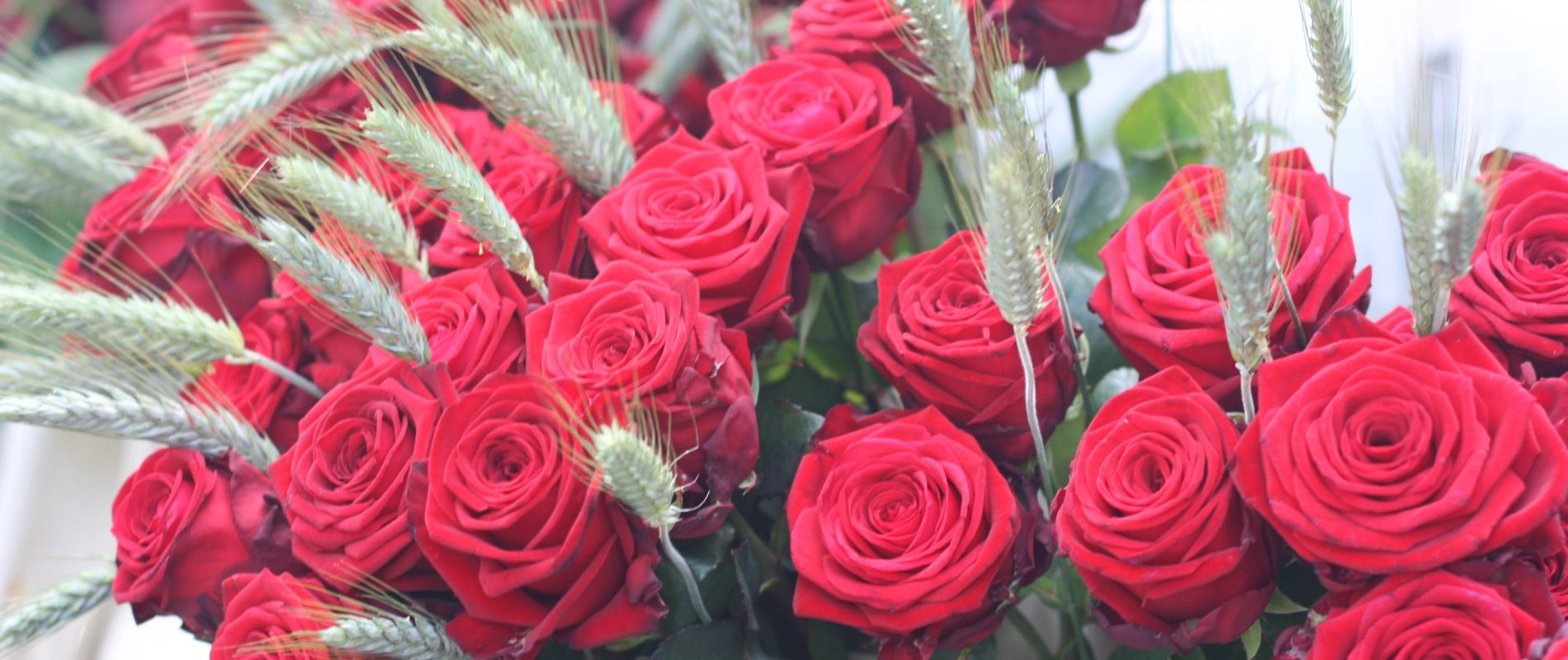
The rose responds to the outcome of the legend. Although today you will find them in all colors (each symbolizing a different feeling), the red rose remains the absolute queen, representing love and affection in their purest state. For Sant Jordi, florists paint Barcelona with the colors of spring as everyone, whether couples, friends, or families, exchanges flowers.
Sant Jordi Gastronomy
The tradition in Barcelona also sits at the table. In the city’s pastry shops, they create laborious chocolate figures of knights and dragons, and it is absolutely essential to try the Sant Jordi Bread: a delicious artisanal cheese and sobrasada bread that, when sliced, reveals the four red and yellow stripes of the Catalan flag.
At HCC Hotels, we want you to live this complete sensory experience, which is why our restaurants have designed exclusive proposals for this April 23rd, 2026:
- Café Lugano Restaurant & Bar at HCC St. Moritz: In an elegant and cozy setting, ideal for taking a break during your tour of the “Sant Jordi Island” in the Eixample, you will be able to taste the Sant Jordi Day Menu available for both lunch and dinner. It is the perfect option for those seeking a unique gastronomic proposal in the vibrant heart of the city.
- El Racó del Montblanc Restaurant at HCC Montblanc: If you prefer to be enveloped by the charm of the Gothic Quarter and the Plaza Catalunya area, El Racó del Montblanc has prepared an exclusive menu that celebrates culture and tradition. Available for lunch and dinner service, it is the ideal place to turn the day into an unforgettable memory surrounded by history.
Whether right in the Eixample or next to the ancient walls, we invite you to celebrate love and culture with us. Reserve your table and put the gastronomic finishing touch on your Sant Jordi!
7. “Barcelona Llibres” new releases: the city told through its pages
For this Sant Jordi 2026, the City Council’s publishing label, Barcelona Llibres, rolls out a catalog that is a true gift for lovers of history, urban art, and the city’s memory. On April 23rd, you will be able to find its official stall on Passeig de Gràcia (between Provença and Rosselló streets), or visit the Ve de Barcelona bookstore in the Born area (Plaza Comercial, 12).
Key Fact: All new releases and backlist titles have a 10% discount during the day. In addition, many of their publications are available for free download on their official website.
The essential picks for 2026:
Graphic Novel and Working-Class Memory
Barcelona relies on the comic format to explain its great social struggles:
- 70 cèntims. La vaga de tramvies de 1951: A graphic novel by Xavier Roca and Xabier Sagasta that revives the first major popular protest against Francoism.
- La SEAT: motor de llibertat: Jordi de Miguel and Cristina Bueno recall the history of the factory that was the vanguard of the struggle for democracy.
- Trini i Laila: A necessary graphic testimony about domestic work and the struggle of women in the Trinitat Vella neighborhood.
Photography and Historical Feminism
- Antifémina: The long-awaited reissue of the 1977 book where photographer Colita and writer Maria Aurèlia Capmany stood up to the post-Franco era with a brazenly feminist perspective. A title that flew off the shelves in 2021 and takes center stage once again.
Architecture, Landscape, and Heritage
- Ruta del Racionalismo de Barcelona: An indispensable guide by Tate Cabré with photographs by Lluís Casals, proposing 9 itineraries to discover the city’s rationalist buildings.
- Estimada Collserola: Raúl Deamo invites us to rediscover the mountain range that embraces Barcelona through drawings made with calm and observation.
- El legado de Nicolau Maria Rubió i Tudurí: A facsimile edition that recovers a 1926 booklet about the great architect and urban planner, accompanied by an exhaustive study.
- De la Zona Franca a la Marina: A visual journey through the evolution of social housing in the Marina neighborhood through floor plans and previously unpublished photos.
Visions of Barcelona
- Històries de Barcelona by David Martínez Herrada: Published by Viena in this 2026, this book is a gem for the curious who want to go beyond conventional guidebooks. It collects 80 surprising episodes and unknown anecdotes ranging from prehistory (when mammoths roamed the “Upper Diagonal”) to forgotten replicas of the Puerta de Alcalá on the Ramblas. Through its pages, you will discover secret graffiti in Park Güell, treasures in Horta, the origin of the iconic Eixample ‘panots’ (paving stones), and even the legend of the Ciutat Vella bell tower that preserves the devil’s footprint. An essential read to look at the city with new eyes during your Sant Jordi stroll.
- Testimonis de tot el món sobre Barcelona: The city’s chronicler, Lluís Permanyer, compiles more than 1,200 quotes from people who have passed through Barcelona over twenty centuries.
- Homenaje a Barcelona: The personal and literary gaze of the prestigious author Colm Tóibín on the Catalan capital.
- Dibuixem Drawing Barcelona: The Urban Sketchers Barcelona collective captures the city live with ink and watercolor, translating the essence of our streets to their notebooks.
For all ages
- 32 bèsties. Bestiari de Barcelona: An interactive book by Laia Berloso and Nico Alonso to color the city’s bestiary, which includes cardboard pieces to assemble 8 beasts of the Popular Retinue in 3D.
8. Barcelona Libraries recommend for Sant Jordi 2026: the experts’ selection
If you are overwhelmed by the immense offering of titles at the stalls, let yourself be guided by those who best know the literary collections of the city. As a prelude to the Sant Jordi Dialogues, Barcelona Libraries have highlighted a series of works that are not only trending but define the cultural pulse of this 2026.
Here are the essential titles that you can find both at the booksellers’ stalls and in the municipal library network:
Essays and critical thinking: understanding our time
- Tecnofeixisme (Donatella Di Cesare): A disturbing and necessary essay on how the governance of experts and technology are creating a new paradigm of power that excludes citizens and reshapes democracy.
- Reference library: Montserrat Abelló.
- Imaginar la fi (Eudald Espluga): Through philosophy and cultural analysis, Espluga dissects why the apocalypse has become our political horizon and how that fear often paralyzes us.
- Reference library: Esquerra de l’Eixample-Agustí Centelles.
Narrative and fiction: from mystery to memory
- Tinta i sang (Han Kang): You cannot miss the latest work by the 2024 Nobel Prize in Literature. On this occasion, Kang surprises with a noir-esque story where the true mystery is not the crime, but the complex interior of its protagonists.
- Reference library: Fort Pienc – Ana María Moix.
- Revolución (Hugo Gonçalves): Winner of the Fernando Namora Prize, this novel transports us to the turbulent days of the end of the dictatorship in Portugal, moving between the hope for change and the ghost of a civil war.
- Reference library: Vapor Vell.
- No la dejes sola (Desirée de Fez): The author’s highly anticipated literary debut. A suffocating novel about family ties, hidden fears, and how anxiety can push a conventional life to the limit.
- Reference library: Xavier Benguerel.
- Una chica en la ciudad (Mercè Ibarz): An essential generational testimony about the Barcelona of 1971. The arrival of a young woman in a city vibrating with feminist counterculture, free love, and the end of the dictatorship.
- Reference library: El Carmel – Juan Marsé.
HCC Hotels Tip: If any of these books catch your attention, you can check their availability in the Barcelona Libraries catalog to read them calmly after the Diada, or look for them directly at the collaborating publishers’ stalls on the 23rd.
Final tips for experiencing Sant Jordi 2026
- Look for the detail: Don’t just settle for the classic rose; seek out the stalls of social entities where every flower helps a cause.
- Explore the neighborhoods: As you have seen, from Gràcia to the Eixample, every corner of Barcelona has its own way of celebrating the Floral Games or creative workshops.
- Enjoy the atmosphere: Sant Jordi is, above all, a festival of citizen participation. Let yourself be carried away by the sea of people, go into the bookstores that spill out onto the street, and experience the most beautiful day of the year.
From HCC Hotels, we hope this Sant Jordi 2026 is an unforgettable experience for you. May you find that book that will stay with you forever and that rose that reminds you of the magic of our city. Feliç Diada de Sant Jordi 2026! (Happy Sant Jordi Day 2026!)