Barcelona is not only explained through its streets, its light, and its modernist architecture; there is also an invisible city, excavated in the subsoil, that narrates one of the most decisive stages of its contemporary history. Rediscovering the anti-aircraft shelters in Barcelona is a necessary exercise to understand the resilience of the people who inhabited the city during the Spanish Civil War.
This route is not just a tourist tour; it is a sensory and emotional journey through the “Barcelona Model”, a passive defense system that became a global benchmark thanks to collective organization.
1. The birth of the “Barcelona Model”: vanguard in passive defense
Barcelona occupies a tragic place in the history of modern aviation: it was the first major metropolis to be systematically and repeatedly bombed targeting the civilian population. Between January 1937 and January 1939, the city suffered nearly 200 attacks by the Italian Aviazione Legionaria and the German Condor Legion. These armies used the skies of Barcelona to rehearse the terror tactics that, a few years later, they would apply during the Second World War. Faced with the magnitude of the threat, which did not distinguish between war fronts and residential areas, civil society and Catalan institutions promoted an unprecedented response.
Engineering at the service of life: Ramon Perera’s vision
The mastermind behind this protection network was Ramon Perera, an engineer of barely 31 years old integrated into the Passive Defense Board of the Generalitat. Perera did not limit himself to creating simple tunnels; he designed a construction standard that today architecture and engineering teams qualify as visionary.
His proposal, known as the “Barcelona Model”, was based on several highly efficient technical pillars:
- Strategic depth: The shelters were excavated at an average depth of between 8 and 12 meters, guaranteeing a sufficient layer of earth to cushion a direct impact.
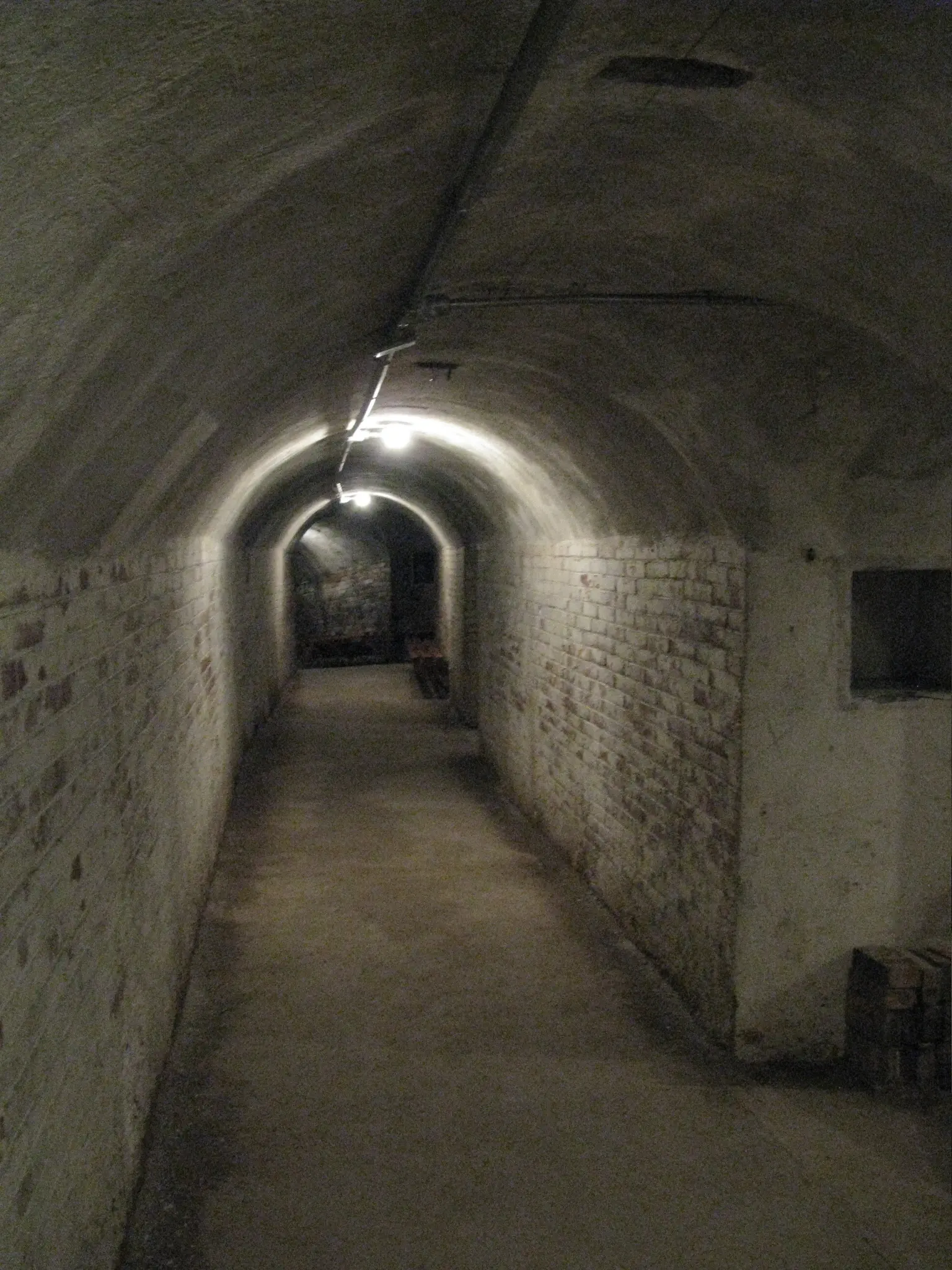
- Structural resistance: The technique of the Catalan vault (vuelta catalana) with exposed brickwork was used. This brick arch was not only economical and quick to build, but its flexibility allowed it to absorb the vibrations of explosions without collapsing.
- Zigzag entrances: Access tunnels were never straight. The right-angle or zigzag design was vital to dissipate the blast wave and prevent shrapnel from entering the common rooms where people were located.
- Ventilation and sealing systems: Ventilation shafts were incorporated to ensure oxygen, and double doors to protect the population in the event of toxic gas attacks.
The collective effort: A city turned into an anthill
What makes Barcelona’s subterranean heritage unique in the world is its grassroots origin. In the capital alone, nearly 1,400 anti-aircraft shelters in Barcelona were built, and the vast majority were the result of neighborhood self-organization. At a time when public resources were scarce due to the conflict, people organized themselves into neighborhood boards:
- Division of tasks: While people with knowledge in mining or construction dug the galleries, the elderly and children carried out the grueling task of removing the rubble in baskets and buckets to the outside.
- Technical solidarity: Local engineers and architects voluntarily advised the communities to ensure that each tunnel complied with Perera’s safety regulations.
- Grassroots funding: In many cases, materials were purchased through neighborhood collections, demonstrating that the defense of life was a shared responsibility.
The “Barcelona Model” vs. the British failure
The effectiveness of Barcelona’s shelters was such that it attracted international attention. The British engineer Cyril Helsby visited the city and was amazed: beneath the subsoil of Barcelona, no fatalities from a direct hit were known.
When World War II broke out, Helsby tried to get the United Kingdom to adopt Perera’s deep tunnel system (who even went into exile in London to advise them). However, the conservative British government at the time dismissed the model, arguing that hiding underground would encourage “cowardice and laziness” in the population. They opted for the Anderson Model (small metal garden sheds), which proved ineffective against large-caliber bombs. The figures are devastating: the lack of a network of deep shelters like the one in Barcelona contributed to the deaths of more than 40,000 people in London, a figure eight times higher than all the victims of the bombings in Catalonia during the Civil War.
2. The visitable shelters: a journey through the underground resistance
Barcelona has a network of recovered spaces that allow visitors to experience the atmosphere of confinement and solidarity that was lived underground. Here is the detailed guide to the anti-aircraft shelters of Barcelona that are the most emblematic of the city:
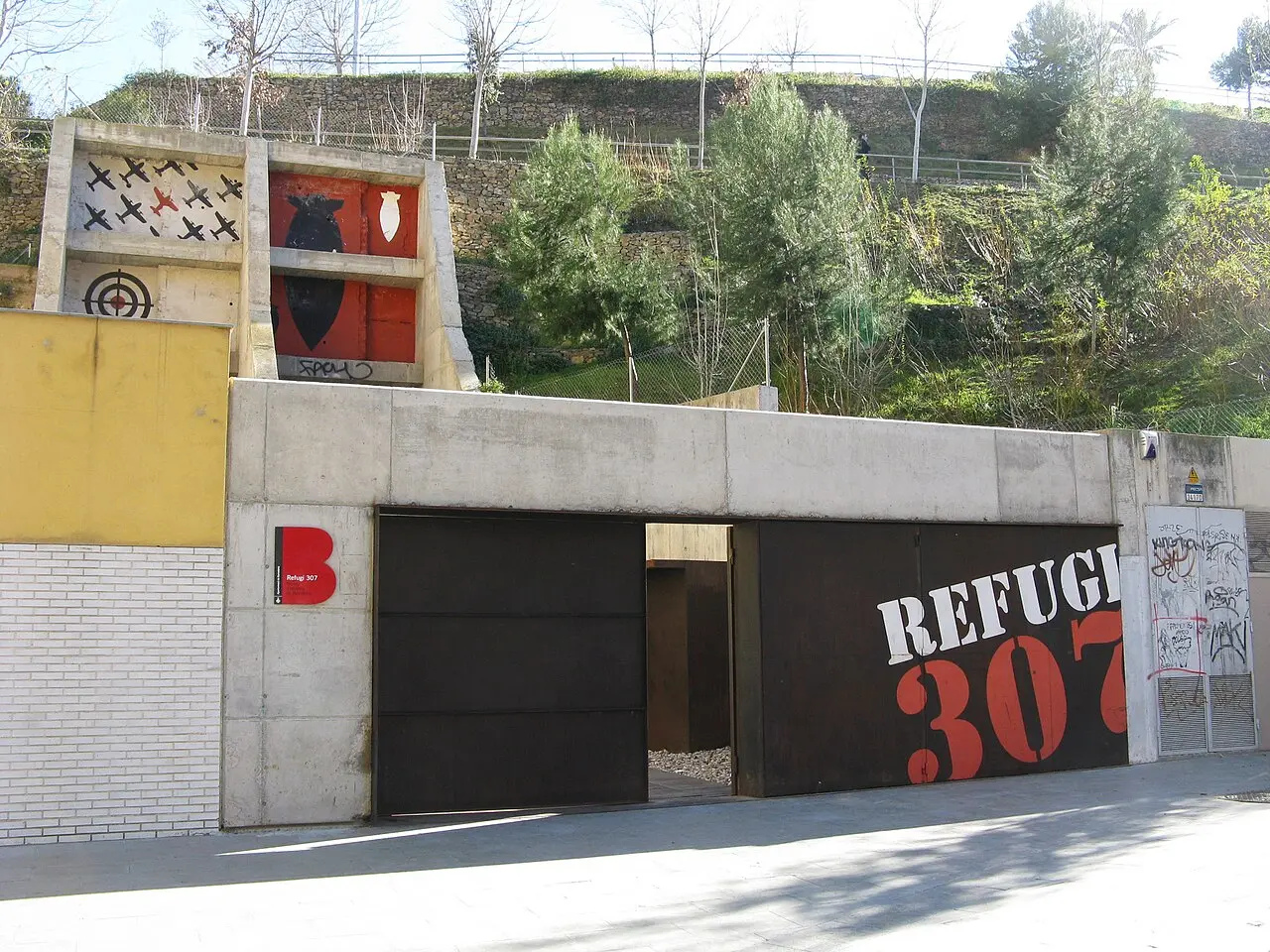
Refugio 307 (Poble-sec): The city under the mountain
This shelter is the great benchmark of the MUHBA (Museu d’Història de Barcelona) network. Located at the foot of Montjuïc mountain, it is an authentic memorial to the struggle for survival and the disaster of wars.
- Curiosities and Construction: It was excavated thanks to the tireless work of many people from the Poble-sec neighborhood. It has nearly 400 meters of tunnels with a height of 2.10 meters. The most surprising thing is its grassroots engineering design: residents excavated the rock, advised by professionals, to create a structure capable of withstanding direct impacts.
- Facilities: It was conceived as a micro-city so that the stay would be as least traumatic as possible. It has rooms that today seem implausible underground: toilets, a water fountain, an infirmary, and even a children’s room and a fireplace.
- Social Importance: Its capacity for 2,000 people sitting on wooden benches prevented mass tragedies in one of the most punished neighborhoods, where many families lost their homes up to three times due to bombings.
Information for the visit (Refugio 307):
- Location: Nou de la Rambla, 175. Metro Paral·lel (L2 and L3).
- Hours: Sundays (except main public holidays). Tours at 10:30 am (English), 11:30 am (Spanish), and 12:30 pm (Catalan).
- Prices: General admission €3.50. Free with Barcelona Card and Gaudir+.
- Observations: Monday to Saturday are reserved for guided groups (maximum 20 people) with prices between €75 and €127. Advance booking required.
Plaza del Diamant Shelter (Gràcia): The silence of brick
This shelter is one of the largest of the more than 1,300 built in the city and one of the 90 that the Gràcia neighborhood housed.
- Depth and Conservation: Sunk 12 meters underground, the network of 250 meters of narrow tunnels has been exceptionally preserved thanks to stable humidity and temperature.
- Curiosities: It was rediscovered in 1992 thanks to works on an electrical station and the tenacity of a historian who had proof of its existence. Walking through it, you can still see the marks from the smoke of the candles that people brought for illumination when the electricity failed, and the original toilets from the era.
- Experience: It is an exceptional opportunity to understand the archaeology of resistance, where visitors actively participate by interpreting the role of those who hid there upon hearing the factory sirens.
Information for the visit (Plaza del Diamant):
- Location: Plaza del Diamant (Gràcia). Metro Fontana (L3).
- Hours: Guided tours every day at 11:00 am.
- Prices: General admission €3. Groups (minimum 20 people): €60.
- Observations: Tour in Catalan (except the second Sunday of the month, which is in Spanish). Organized by: Associació Taller d’Història de Gràcia.
Plaza de la Revolución Shelter (Gràcia): Hygiene and Health
This shelter (number 267) stands out for its pedagogical approach to health in times of war.
- Singularity: It was closed in 1939 and saw the light again in 1994. Although only 5% of the original construction is preserved (a fragment of the corridor, the infirmary, and the first aid kit), its museum presentation is impeccable.
- Curiosities: Unlike others, its walls are coated with plaster. For visitors to understand its original magnitude, the layout of the shelter has been represented on the pavement of floor -4 of the current parking lot. The original inscription “CURAS” (Treatments/Cures) can still be seen at the entrance to the medical rooms.
Information for the visit (Plaza de la Revolución):
- Location: Floor -4 of the Plaza de la Revolución parking lot. Metro Fontana (L3).
- Hours: Sundays at 12:15 pm.
- Prices: General admission €3. Groups (minimum 20 people): €60.
- Observations: Tour in Catalan (second Sunday of the month in Spanish). Organized by: Associació Taller d’Història de Gràcia.
La Sagrera Anti-aircraft Shelter: The Tower of Memory
Located beneath the Torre de la Sagrera building, this 1937 shelter combines private use with service to the neighborhood.
- Evolution: It was likely promoted by the delegates of the collectivized United Shoe Machinery company. It is located where Joan Arpí’s tile factory originally stood.
- Curiosities: It is a high technical quality shelter that served to protect the people who worked in the industry and the families in the area. It is a key point managed today by the Casal de Barri.
Information for the visit (La Sagrera):
- Location: C/ Berenguer de Palou, 64. Metro La Sagrera (L1, L5, L9N, L10).
- Hours: From September to June, Fridays (four shifts from 4:30 pm) and Saturdays (four shifts from 10:00 am).
- Prices: General admission €6.50. Maximum capacity of 5 people per visit (duration: 1 hour).
- Special event: Nit dels Museus 2026 (May 16th): Free admission from 7:00 pm to 1:00 am.
Palau de les Heures Shelter: The institutional shelter
This space is unique because its purpose was to protect the President of the Generalitat, Lluís Companys.
- Political Context: The President moved to this palace away from the center to avoid the strategic targets of fascist aviation. The shelter is located in the basement of the palace.
- Curiosities: It keeps the original electrical installation intact. It is a tunnel about 40 meters long with a concrete vault and brick walls of great technical consistency, even including its own ventilation shaft.
Information for the visit (Palau de les Heures):
- Location: Mundet Campus. Metro Mundet (L3).
- Observations: Visits are not regular; they are subject to requests accepted by the University of Barcelona and the Barcelona Provincial Council.
3. Practical guide to plan your visit to the anti-aircraft shelters in Barcelona
Visiting anti-aircraft shelters in Barcelona is not a conventional tourist activity; it is an immersion in a sensitive historical space. For the experience to be satisfactory, it is important to keep the following points in mind:
Booking management and planning
- Advance booking essential: Due to the limited space in the tunnels and the need to preserve the indoor microclimate, groups are small. For the Gràcia shelters (Diamant and Revolució), managed by the Taller d’Història de Gràcia, and 307 (managed by the MUHBA), spots usually sell out weeks in advance, especially for tours in Spanish or English.
- Punctuality: It is recommended to arrive at least 10 minutes before the scheduled time. Once the descent into the shelter has begun, for safety reasons, it is not possible to join the group.
Digital tools: The map of the invisible city
- Cartography of memory: The Barcelona Archaeology Service has developed an interactive map of the anti-aircraft shelters in Barcelona which is an exceptional consultation tool. It shows not only the visitable shelters but the more than 1,400 documented points throughout the city. It is ideal for people to check if an underground shelter existed beneath their own street or building during the war.
Health, accessibility, and comfort
- Environmental conditions: Underground, humidity usually exceeds 70% and the temperature remains constant between 14°C and 16°C. Even if it is hot outside, it is recommended to bring a light jacket.
- Access restrictions: Due to the nature of the original constructions (narrow corridors, low ceilings, and steep stairs), most of the shelters are not accessible for wheelchair users or people with severe reduced mobility. Likewise, entry is not recommended for people with claustrophobia or severe respiratory conditions due to the feeling of confinement.
- Clothing: The use of closed and comfortable footwear is mandatory (avoid heels or open sandals). The floor can be uneven or slightly damp, so good grip is key to avoiding slips.
Rules during the tour
- Photography and video: Generally, taking photos without a flash is allowed so as not to dazzle the rest of the group or alter the atmosphere of the place. However, in some specific spaces (like 307), video recording may be restricted.
- Respect for the environment: These are memorial spaces. You are requested not to touch the original brick walls to prevent the oil from your hands from encouraging the growth of microorganisms that damage the structure.
Walking through the underground passages of Barcelona is, above all, an act of profound empathy. It means putting yourself, if only for a few moments, in the shoes of thousands of people who, in dramatic conditions and under the sound of alarms, decided not to give up, to take care of each other, and to resist collectively.
These shelters are not just brick and concrete tunnels; they are monuments to life. They remind us that, even in the darkest moments of our history, citizen organization and the solidarity of a people were able to build protective structures against destruction. Upon emerging back into the city light, visitors will not only have learned a historical fact, but will carry with them the legacy of a Barcelona that managed to stand tall, even while being underground.